MN Ice Dam Removal

Our MN ice dam removal service is roofer owned and offers fast arrival times. Same or next day service with low pressure (100 psi) steam is available to safely eliminate ice dams and roof leaks. We are fully insured and experienced. In fact, the owner has 20+ years of experience removing ice dams from roofs. Please call or text us at 612-919-4185 or simply contact us here.
We are a trusted and transparent MN ice dam removal service boasting over 150+ videos on ice dam removal. If your ice dams are causing roof leaks we can stop the damage quickly. We use pressure and temperature gauges on all of our steamers showing customers our low 100 psi and very high steam temps.
Watch our 29-minute MN ice dam removal video below from start to finish or with time stamps to learn about low pressure steam ice dam removal, our equipment, our advice and our process.
Read the video transcript
We were called to this home because of the ice coming down the siding here. You see how much ice is coming down the siding. That’s a really good indication that the ice dam is causing a problem in your building. You could already have water and ice in that wall cavity. So if you see anything like that on your building, give us a call. We’re going to throw some video in here of us steaming the ice, a little bit of us shoveling, and a little bit of the machine as well, and we’re going to talk about low pressure steam today. So thank you so much for watching this video. I really appreciate it.
Hey everyone, just coming to you with the second part of this job. The second part of this job is three stories in the back. I’ve got my safety harness on, and we’ve got our safety system all set up and in place. We’re gonna to get steaming. We’re going to get up over the roof and onto the back side. It’s pretty steep, but we’re going to be tied off and using all the safety precautions I was trained to use as a roofer.
Basically, again, we’re using low pressure steam. There’s no trigger on this gun, and there’s no colored nozzles. This is the system you’re looking for if you’re going to have ice dams removed from your roof. If you see anything different than this, it’s more than likely a pressure washer, and you shouldn’t let them on your roof.
So we’re going to take a look at the temperature and the pressure that this machine is running at today. We’re running at only 100 PSI, and we’re running at 275 degrees Fahrenheit continuously. The burner on this machine will continue to run the entire day. It doesn’t cycle on and off and on and off. It stays running the entire day, which means a consistent temperature down on your shingles all day long, and a consistent pressure.
If there’s a trigger on the gun, it’s going to control the burner. The burner is going to go on and off and on and off, and that means it’ll go down to water and back to steam, water to steam. That’s not what you’re looking for. You want the guy on the roof to not be able to control the temperature of this machine. The only way we can adjust the temperature of this machine is basically by shutting it off.
So, let’s look at the gauges here. This is the temperature gauge. We’re running at 275. It’s a little over. We can run up to 290 degrees Fahrenheit if we want to. And you can see in the bank there we’re running at 100 PSI. The needle is vibrating a little bit on the machine there, but you can see it’s right at 100 PSI. So that’s a good, safe pressure. A hot pressure washer typically runs at about 1,000 PSI minimum. They can run up to 3,000 PSI, and they typically only use hot water, you know, 180 to 200 degree hot water, and that’s not even boiling water. So you want low pressure, gentle steam.
So we’re going to get all tied up, we’re going to get up there and start steaming. We’ll take a little bit of video up there as I’m steaming and all tied up. You’ll see me from the backyard, three stories up on this building.
If you need an ice dam removed safely with low pressure steam anywhere in Minnesota, please give me a call. I’ve got over 20 years of experience, and we’re fully insured. We’re going to focus on this magnet here for a minute to let you write down our phone number. Please give me a call. You can also text me on that number there. I’ve got more information on ice dam removal than any company in the world. I’ve got 150 or so YouTube videos on steam ice dam removal. So if you’re looking for a good company that truly cares about the condition of your roof after we’re out, please give me a call at 612-919-4185. Thank you so much.
All right, everyone. We’ve got our rope and harness system all set up. We’re on this roof. This is about a 12/12 pitch, and we’re three stories off the ground. I’ve been doing this for 20 years. I was a roofer most of my life, and I like to do some of the jobs that nobody else will take on because they’re just too scary or too dangerous. That’s the kind of stuff I like to do.
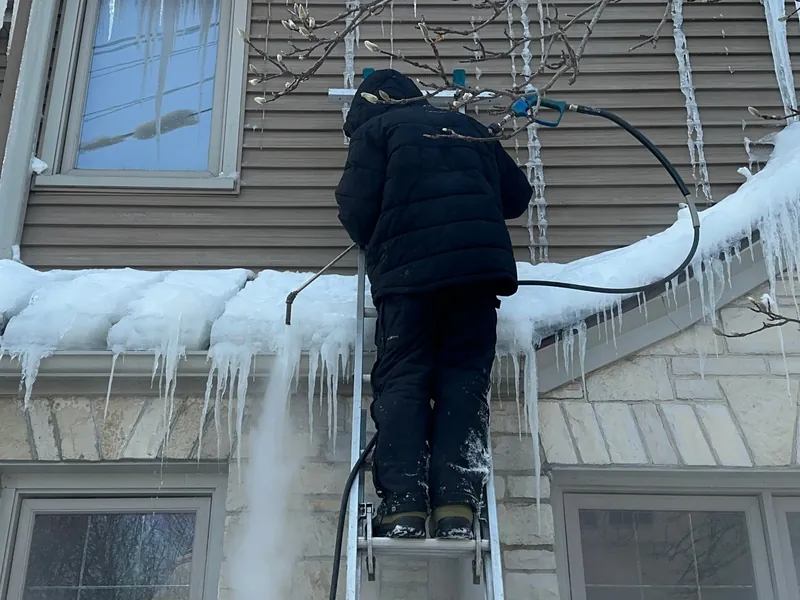
As you can see right down here, we’ve got a little dryer vent, and that created a little bit of the heat up here. There’s a big ice dam down here, and there’s a very small overhang. There’s about a six inch soffit down here, and so the ice dam on this roof is pretty significant and very, very close to leaking inside the home. As you can see, we’re up here steaming. We’ve pushed some of the snow down. We’ve got a safety edge in front of us here, and I’m going to get right down. I’m not putting too much water up here, basically just enough water to make a path down for me to walk. The snow is soaking up whatever steam I’m creating, and then I’m going to get my way down to the edge, and I’m going to start cutting that ice dam open, and then I’m going to start steaming it off. We’ll have a couple of pictures from the ground just to show you how high we actually are here.
But if you need an ice dam removed anywhere in Minnesota, and you’re looking for someone who cares about your property, please give me a call at 612-919-4185. Thank you so much.
So as you can see, we’ve got a safety edge created down here with the snow. In the roofing union, we were taught to create a safety edge of snow on the edge of the roof, and you’re never supposed to stand where that safety edge has been removed. So we use this safety edge for our safety. We never stand on an open roof and risk sliding down. This edge of snow here is my safety. It’s not going anywhere. If I slip on this roof, I’m not going to slide off this roof. I’m going to be caught by the snow, and that’s why we call it our safety edge. Its very important.
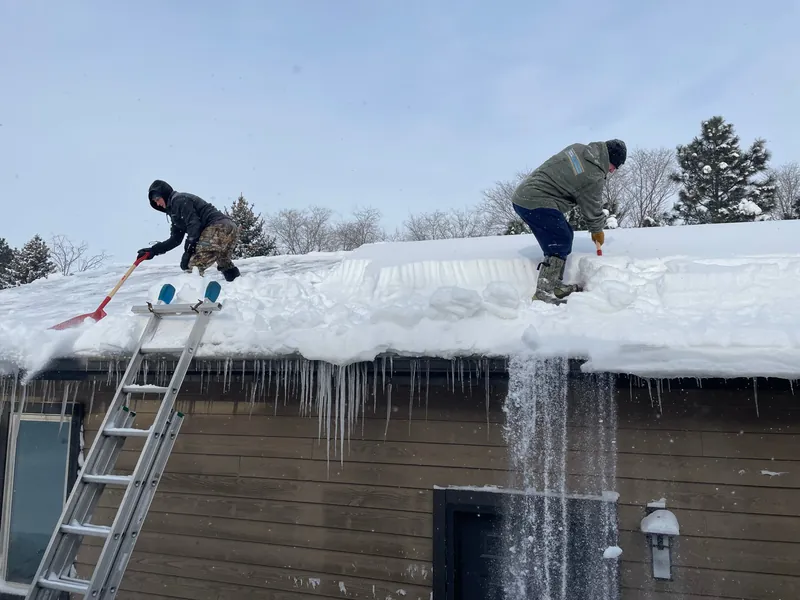
Okay, so as you can see, I can just walk along the safety edge. I’m going to do a little more shoveling. You’re never supposed to shovel up on a roof or sideways, but when you have as much experience as I do doing this, you can do it, but you’ve got to be careful of your shovel angle okay. So as you can see, I can go ahead and get some of that snow and let it slide right down. Get some of this snow, let it slide down. Basically, I’m making my safety edge. I’m not pushing this snow off the roof. I’m actually making this roof safe for me to walk on okay. So again, you’re never supposed to shovel sideways, but when you’ve got as much experience as I do on a roof, that’s okay. So that safety edge is real nice.
There’s a heat vent right here somewhere. I’m trying to leave that right there okay. I’ll take my shovel and put it behind me. I’m going to give myself a little bit more rope here, and I’m going to get over to the edge and start dealing with the ice dam okay. So I’m going to go ahead and get it cut open here. I’m just gonna spray the steam down here along the thickest part of the ice first and get it cut open.
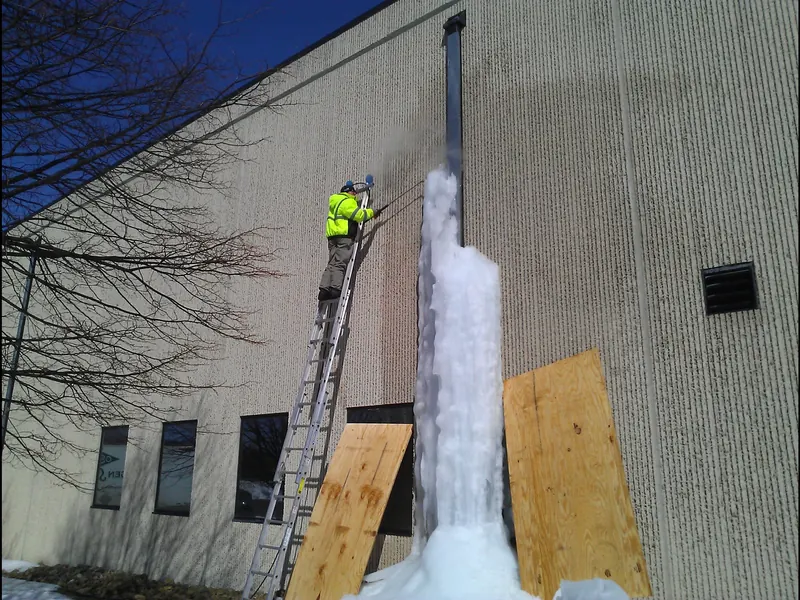
Before we drop any of this ice on the ground, we’re going to have someone on the ground identifying anything in the way of the ice falling off, like air conditioners and things like that. We’ll get them protected with plywood if necessary, and then we can drop the ice off the roof safely without hurting anything on the ground.
We don’t wanna start pump too much water up here, and creating to much ice and snow melting and then it comes into the home. So you’ve got to open up the ice dam first. We put just enough steam up here to walk down safely. The snow soaks it up, and it doesn’t sit behind the ice dam and come in the home. So you’ve got to be careful who you hire to do this. If they’re making a path down the roof before they open up the ice dam, they’re putting too much steam up here, creating too much melting that could cause a leak inside your home.
We’ve been doing this 20 years, and if you need a good company to remove your ice dams, please give me a call. We use the best low pressure steam equipment in the industry today. We run temperature and pressure gauges on our machine at all times. We’re highly against pressure washers on roofs. It’s very dangerous. Never allow a trigger gun or a colored plastic nozzle on your roof, ever. We’ll give you some pictures from the ground as well, just to show you how high I am off the ground here. And like I said before, there’s not a lot of companies that would consider doing a job like this. We’ve been doing this 20 years, and these are the kind of jobs I enjoy. I kinda get bored sometimes with the flatter pitch roofs and real simple stuff. I like this. So if you have any properties that you need ice dams removed from, please give me a call. Thank you so much.
I want to just talk about one more thing here that you need to look out for when you’re hiring a company to remove your ice dams. Look at their feet. Make sure they’re not wearing any cleats or metal spikes on the bottom of their feet. There are a couple of companies that I know of right now that are fairly big. They run a lot of guys and a lot of machines, and they require their guys to wear spikes or cleats on their feet. That’s very, very bad. You do not ever, ever want to let someone wear metal spikes or cleats on the bottom of their boots, ever, on your roof. It will shorten the lifespan of your roof, it’ll void your warranty, and cause premature roof failure at the very least. Your roof will end up being curled up and dried up because the limestone has been removed from the shingles. So the whole goal of what we’re doing here today is trying not to remove limestone from the shingles. That’s very, very important. You never want to remove limestone from the shingles, not even a little bit, from the bottom of your boots with spikes on there. It’s very, very bad, and so just look at their feet.
Now, as you can see here today, there’s absolutely nothing on the bottom of my boots. They’re just regular rubber boots. These are from Cabela’s. There’s nothing special about them other than they’re really warm. So that’s what you’re looking for, just normal boots. So watch out for that. Thank you so much.
Everyone, as you can see, we got this job done safely. Both sides are completed. We did not need to use any cleats or metal spikes on the bottom of our boots to be safe up here. This is about a 10/12, possibly even a 12/12 here, so it’s very steep in most circumstances for most people. But as you can see, we do not need to use cleats or spikes on the bottom of our boots. These are just rubber boots. I want to emphasize this again, any company that wants to wear cleats or spikes on the bottom of their boots on your roof should never be allowed on any roof, ever again. So look for a company that wears just rubber boots, like us. If you’d like to hire us, please give us a call at 612-919-4185. Thank you.
What’s in this video
- 0:30 Showing you the roof leak
- 1:04 Opening the lower ice dam
- 1:19 Removing the upper ice dam
- 2:48 Steaming lower dams
- 2:54 Education about steam
- 5:50 Steaming the three story roof
- 11:11 View from the ground
- 16:19 Advice from a roofer
- 17:43 Finishing the left side
- 27:03 Final advice
MN Ice Dam Removal
Our MN ice dam removal service specializes in residential and commercial ice dam removal. We remove ice dams with steam across all of MN including Minneapolis, St. Paul, Duluth, Brainerd and Rochester.
MN Ice Dam Removal: History & Experience
 We have the experience and knowledge to remove ice dams from any MN property. So please enjoy the video above. We have lots more videos if you’d rather watch than read.
Our experience removing ice dams goes back over 20 years. All the way back to the start of the owner’s roofing career in the union. The owner Jesse worked for union and non-union companies for 10+ years. And during most winters he worked removing snow and ice dams from roofs. Add another 16+ years here removing ice dams and you have over 20 years of experience. In fact the owner is often times on job-sites steaming ice dams in a cloud of warm steam.
Here’s What Customers Are Saying About Our MN Ice Dam Removal Service

How Are Ice Dams Removed
 From our experience there are several ways to try removing an ice dam from a roof. However, only low psi steam will truly leave your roof in the same condition as it was prior to the ice dam removal. We have perfected steam ice dam removal throughout the years. Please call or text us at 612-919-4185 or simply contact us here.
As a roofer I have tried several methods of ice dam removal, such as hammers, ice melt chemicals, salt socks, even torches. However all these methods are inferior to ice dam steaming. Low psi steam is the only method I use and recommend to remove ice dams.
And one very important mention here is to avoid impact to smash the ice dam and also avoid high psi from hot or cold pressure washers as these methods are damaging to the roof.
For safe gentle steam please call or text us at 612-919-4185 or simply contact us here. We have fast arrival times for customers with roof leaks!
Operating out of our Garrison, MN base, our specialized ice dam steaming crews travel statewide to protect properties from winter roof leaks.
Our MN Ice Dam Removal Service Coverage Area
We remove ice dams across all of MN including: Albert Lea, Aitkin, Albertville, Alexandria, Andover, Annandale, Anoka, Apple Valley, Arden Hills, Arnold, Atkinson, Austin, Babbitt, Backus, Bagley, Barnum, Baxter, Bayport, Becker, Belle Plaine, Beaver Bay, Bemidji, Big Lake, Biwabik, Blaine, Bloomington, Brainerd, Breezy Point, Brooklyn Center, Brooklyn Park, Brookston, Bruno, Buffalo, Buhl, Burnett, Burnsville, Cambridge, Carlton, Center City, Centerville, Champlin, Chanhassen, Chaska, Chisago City, Circle Pines, Clear Lake, Clearwater, Cloquet, Cokato, Cold Spring, Columbia Heights, Coon Rapids, Corcoran, Cottage Grove, Croftville, Cromwell, Crookston, Crosby, Cross Lake, Crystal, Cuyuna, Dassel, Deephaven, Deer River, Delano, Dellwood, Detroit Lakes, Duluth, Eagan, East Bethel, East Gull Lake, East Grand Forks, Eden Prairie, Edina, Elk River, Emily, Esko, Eveleth, Excelsior, Fairmont, Faribault, Fairhaven, Falcon Heights, Fergus Falls, Farmington, Floodwood, Foley, Forest Lake, Frazee, Fredenberg, French Lake, Fridley, Garrison, Gilbert, Glencoe, Golden Valley, Grand Lake, Grand Maris, Grand Portage, Grand Rapids, Greenwood, Grove City, Hackensack, Ham Lake, Hanover, Harney, Harris, Hastings, Hasty, Hermantown, Hibbing, Highland, Highland Park, Hinkley, Holyoke, Hopkins, Howard Lake, Hugo, Hutchinson, Independence, International Falls, Inver Grove Heights, Isabella, Isanti, Iverson, Kasson, Kettle River, Kimball, Knife River, Lake Elmo, Lakeville, Larsmont, Lauderdale, Lexington, Litchfield, Lindstrom, Lino Lakes, Little Canada, Little Falls, Little Marais, Little Rock, Long Lake, Lutsen, Mahtomedi, Mahnomen, Mahtowa, Mankato, Maple Grove, Maple Lake, Maple Plain, Maplewood, Marshall, McGregor, McGrath, Medina, Mendota Heights, Milaca, Minneapolis, Mpls, Minnetonka, Minnetonka Beach, Minnetrista, Montevideo, Monticello, Montrose, Moorhead, Moose Lake, Mora, Mound, Mounds View, Munger, New Brighton, New Hope, New Prague, New Ulm, Nisswa, North Branch, North Mankato, North Minneapolis, North Oaks, North St. Paul, Northfield, Norwood Young America, Nowthen, Oak Grove, Oak Park Heights, Oakdale, Onamia, Orono, Otsego, Otter Creek, Ottertail, Owatonna, Palmers, Park Rapids, Paynesville, Pelican Rapids, Pine City, Plymouth, Princeton, Proctor, Prior Lake, Ramsey, Red Lake, Red Wood Falls, Red Lake Reservation, Red Wing, Redby, Richfield, Richmond, Robbinsdale, Rochester, Rock Creek, Rockford, Rockville, Rogers, Rosemount, Roseville, Rush City, Saginaw, Sandstone, Sartell, Sauk Center, Sauk Rapids, Savage, Sawyer, Scanlon, Scandia, Shakopee, Shoreview, Shorewood, Silver Bay, Silver Creek, South Haven, South Minneapolis, South St. Paul, Spring Lake Park, Stacy, Staples, Stewart, Stillwater, Sturgeon Lake, St. Anthony, St. Augusta, St. Cloud, St. Francis, St. Joseph, St. Louis Park, St. Michael, St. Paul, St. Paul Park, St. Peter, Tamarack, Thief River Falls, Tofte, Tonka Bay, Tower, Twig, Two Harbors, Vadnais Heights, Victoria, Virginia, Waconia, Wadena, Waite Park, Walker, Waseca, Watertown, Wayzata, Waverly, West St. Paul, White Bear Lake, Willmar, Willow River, Winona, Winsted, Woodbury, Worthington, Wrenshall, Wright, Wyoming and Zimmerman MN
Ice Dam Removal Questions
How much does ice dam removal cost?
We can give you a close estimate if you text us pictures from the ground of your building. We will then multiply our hourly rate by how much time we think the job will take. The price depends heavily on the size of the roof, how steep it is, and how much snow and ice there is. We can set a cap on the time and work within your budget. Text us pictures for a quick estimate.
Will steaming damage my roof?
Low pressure steam melts the ice without damaging the roof composition. Chipping or hammering the ice is the main way roofs and gutters get damaged during removal. Steam is so gentle it will not even damage a pair of salt filled pantyhose that we often find on the ice dams. Many customers with nice roofs call and exclusively request us because they know from our videos that we are passionate about low pressure steam for ice dam removal. Tell us about your roof when you call.
Is it safe to remove ice dams myself?
We don’t recommend it. Working on an icy roof or ladder is dangerous, and most DIY methods can damage shingles and gutters. Roofs are very fragile when they are cold so impact should be ruled out entirely. Even just hot water at garden hose pressure can damage a roof. If its not very hot steam at a very low pressure it can do damage, but steam is no longer water so it can’t cut like water and it’s the safest choice for ice dam removal.
Does insurance cover ice dam removal or water damage only?
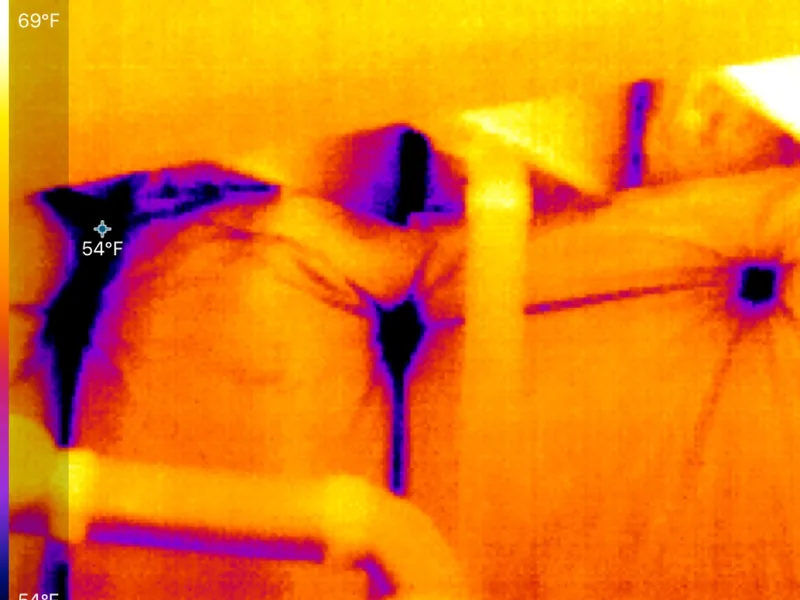
Insurance coverage will almost always cover the interior water damage. Each company varies by policy, so check yours or ask your agent. Many (smart) companies will cover the ice dam removal process also, especially once they weigh the options. If they don’t pay for steaming the interior water damage gets worse and they lose more money. If you can’t pay for the steaming the damages get worse. Good insurance companies should never suggest that someone use a hammer or ice pick etc. We can give your insurance company thermal image video and pictures to help win your claim. In-fact we have won a-lot of insurance claims for our customers. The top video on this page around the 30 second mark talks about it in text on the video with a smiley face.